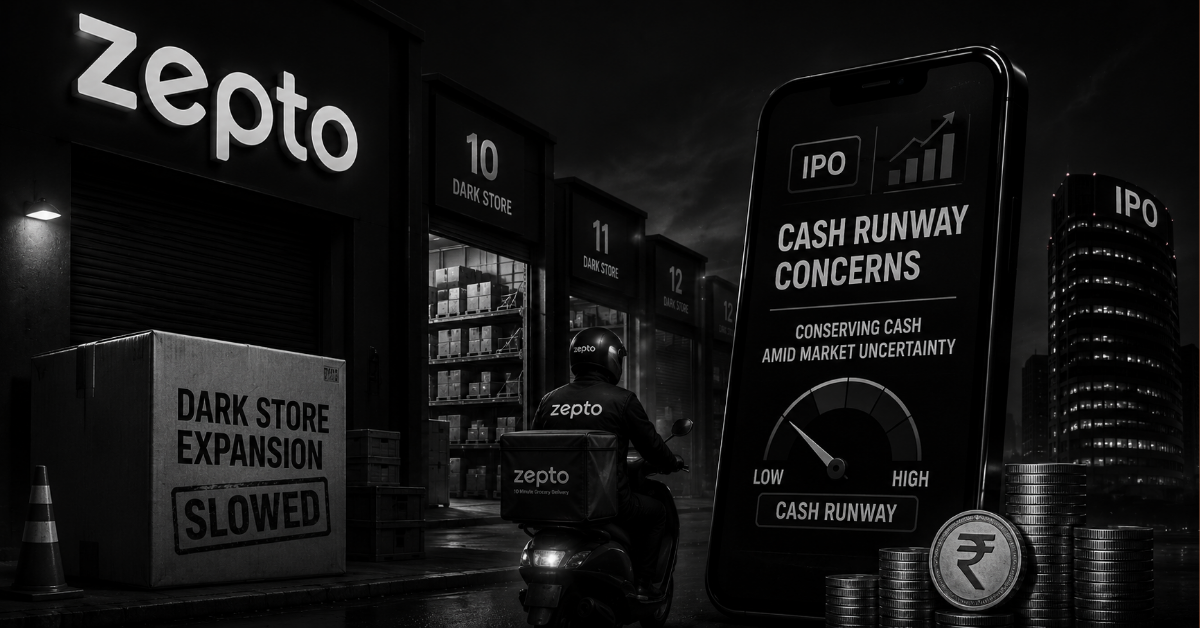
Quick Commerce Startup Appears To Shift Focus From Aggressive Expansion To Efficiency Ahead Of Public Listing
As Zepto moves closer to its anticipated initial public offering (IPO), the quick commerce startup appears to be entering a new phase of growth one focused more on operational efficiency than rapid network expansion.
According to a recent Bank of America (BofA) report, Zepto added just 110 dark stores during FY26, taking its total network to 1,139 locations. The figure marks a significant slowdown compared to FY25, when the company added 692 stores and expanded its footprint from 337 to 1,029 dark stores.
The moderation comes as investors increasingly scrutinize the company’s financial position, growth strategy, and path to profitability ahead of its public market debut.
Expansion Pace Falls Sharply While Rivals Continue To Scale
The slowdown is particularly notable when compared to Zepto’s closest competitors.
Blinkit, owned by Eternal, remained in expansion mode throughout FY26, adding 942 dark stores and ending the year with 2,243 locations. Swiggy Instamart added 122 stores during the same period, taking its network to 1,143 dark stores.
With Zepto and Instamart now operating a nearly identical number of stores, industry observers believe the competitive battle may be shifting away from store count growth and toward improving productivity and profitability at existing locations.
Higher Order Volumes Suggest Better Store Productivity
Despite having a similar dark store footprint to Instamart, Zepto processed significantly more orders during FY26.
According to BofA estimates, Zepto handled approximately 640 million orders during the year, compared to Instamart’s 412 million orders.
The numbers indicate that Zepto’s existing stores are generating higher throughput and handling more customer demand per location, a metric that could become increasingly important as investors evaluate the sustainability of quick commerce business models.
Higher productivity may also allow the company to maintain growth without the heavy capital expenditure typically associated with opening hundreds of new dark stores annually.
Cash Position Raises Questions Ahead Of IPO
One of the biggest factors influencing Zepto’s strategy could be its cash reserves.
BofA estimates that Zepto ended FY26 with net cash of approximately Rs 2,970 crore after accounting for lease liabilities.
Based on the company’s reported Q4 FY26 free cash outflow of around Rs 802 crore, analysts estimate that Zepto currently has roughly 3.7 quarters or approximately 10 to 11 months of cash runway if spending continues at a similar pace.
While the company has not indicated any liquidity concerns, the figures highlight a significantly smaller financial cushion compared to larger rivals.
Blinkit And Swiggy Hold Stronger Cash War Chests
In comparison, Blinkit’s parent company Eternal reportedly held net cash of approximately Rs 13,380 crore at the end of FY26.
Swiggy, meanwhile, had around Rs 12,600 crore in net cash, according to BofA estimates.
Although these balances sit at the parent company level and support multiple business lines, they nevertheless provide substantial financial flexibility to continue investing aggressively in customer acquisition, logistics, and dark store expansion.
This disparity could become increasingly relevant if competition intensifies further in India’s fast-growing quick commerce market.
Zepto’s IPO Strategy May Prioritize Sustainability
The slowdown in store additions suggests Zepto may be prioritizing capital efficiency and improving unit economics ahead of its IPO.
Public market investors are increasingly focused on profitability, cash flow discipline, and sustainable growth rather than expansion at any cost.
By extracting more value from its existing network and demonstrating stronger productivity metrics, Zepto could present a more compelling investment case when it eventually approaches public markets.
The strategy also aligns with a broader trend across the startup ecosystem, where companies preparing for IPOs are placing greater emphasis on operational discipline and financial sustainability.
What Investors Will Be Watching
As Zepto moves toward its public listing, investors will closely monitor whether the company can maintain strong order growth without relying on aggressive dark store expansion.
The company’s ability to improve margins, optimize logistics costs, and extend its cash runway may prove just as important as revenue growth.
For now, the numbers suggest that Zepto is transitioning from a land grab phase to a more mature operating model one that focuses on maximizing productivity from existing assets while conserving capital in preparation for life as a publicly listed company.