Why Is RBI Buying Dollars Again Despite A Stronger Rupee?
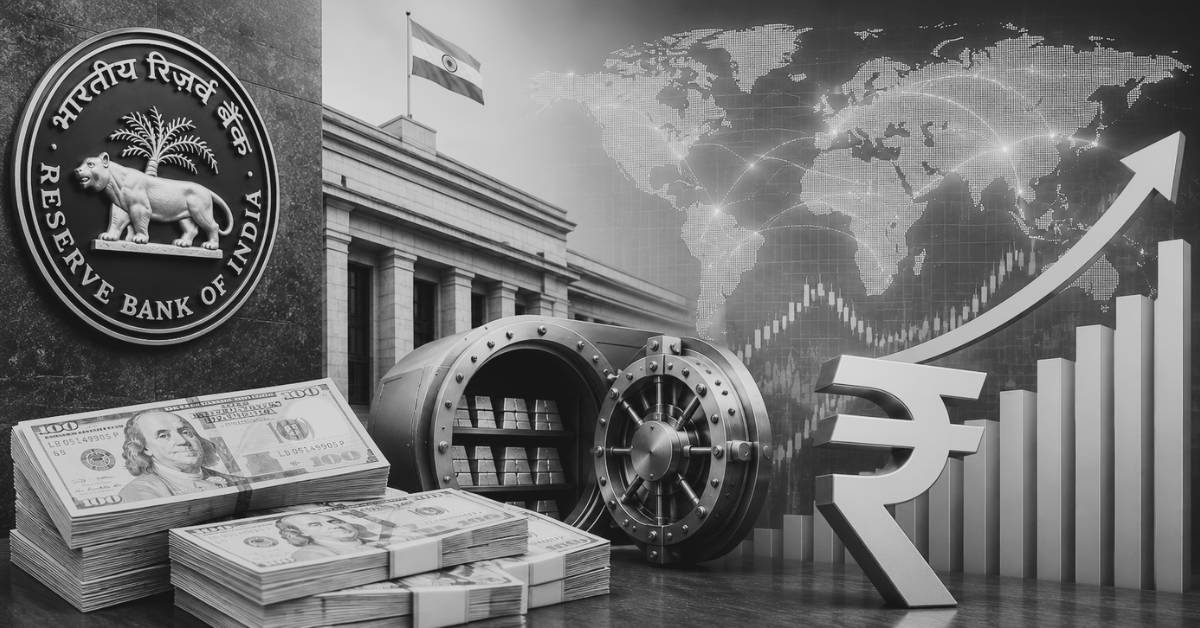
The Reserve Bank of India (RBI) has intensified its dollar purchases in recent trading sessions as the rupee strengthens against the US dollar, taking advantage of improving market conditions to rebuild foreign exchange reserves and manage its sizeable short dollar forward position.
According to market participants, the central bank is estimated to have purchased between $1 billion and $2 billion on Thursday after reportedly absorbing $2 billion to $3 billion from the foreign exchange market a day earlier.
The move comes as easing geopolitical tensions in West Asia and falling crude oil prices have supported the rupee, providing the RBI with an opportunity to replenish reserves that declined sharply during the recent period of market volatility.
How Has The Rupee Performed Recently?
The Indian rupee has emerged as one of Asia’s stronger-performing currencies in recent weeks.
The currency has gained for five consecutive trading sessions and appreciated around 1.5% against the US dollar during this period.
On Thursday, the rupee settled at 94.34 per dollar after touching an intraday high of 94.17, compared to its previous close of 94.53.
The gains came despite a stronger dollar globally after the US Federal Reserve maintained a cautious stance on interest rate cuts.
Market sentiment improved as crude oil prices retreated following reports that the United States and Iran had reached an initial agreement aimed at ending the conflict in West Asia.
Lower oil prices have reduced concerns about India’s import bill and supported the domestic currency.
Why Are Lower Crude Prices Important For The Rupee?
India imports more than 80% of its crude oil requirements, making oil prices a critical factor influencing the country’s trade balance and currency movement.
When crude prices rise, India’s import bill increases, putting pressure on the rupee and widening the current account deficit.
Conversely, declining oil prices improve India’s external position and reduce demand for dollars from oil importers.
The recent decline in crude prices has therefore provided a significant boost to the rupee while easing pressure on the RBI to intervene aggressively in currency markets.
Is RBI Trying To Rebuild Forex Reserves?
A key objective behind the RBI’s recent dollar purchases appears to be rebuilding India’s foreign exchange reserves.
The country’s reserves stood at $681.6 billion as of June 6, significantly lower than the record high of approximately $728.5 billion recorded in late February.
This represents a decline of nearly $47 billion over the past few months.
Much of this reduction resulted from RBI interventions aimed at limiting excessive volatility in the foreign exchange market during periods of heightened geopolitical uncertainty and global risk aversion.
Now that market conditions have improved, the central bank appears to be replenishing those reserves.
What Is The Short Dollar Forward Position RBI Is Managing?
Beyond rebuilding reserves, the RBI is also attempting to manage its large short dollar forward book.
According to central bank data, the RBI’s net short dollar forward position stood at $95.3 billion at the end of April after touching a record $103.1 billion in March.
A short dollar forward position means the central bank has committed to supplying dollars at future dates under forward contracts.
These positions were accumulated as part of the RBI’s efforts to stabilize the currency market during periods of stress.
However, as these contracts approach maturity, the RBI may need to secure sufficient dollar liquidity to meet future obligations.
Market participants believe recent dollar purchases are partly aimed at reducing reliance on these forward positions while strengthening reserve buffers.
How Active Was RBI In Currency Markets Last Year?
The central bank was one of the most active participants in the foreign exchange market during FY26.
According to RBI data, the central bank net sold $53.13 billion in the spot market during the financial year, marking its largest annual net dollar sale on record.
The intervention came as the rupee depreciated nearly 10% during the year amid global uncertainty and capital outflows.
The most intense interventions occurred in October and December, when net dollar sales reached $11.88 billion and $10.02 billion, respectively.
Although RBI briefly turned into a net buyer during January and February, it resumed selling in March, offloading a net $9.76 billion.
Will RBI Continue Buying Dollars?
Currency dealers expect the RBI to remain an active buyer whenever the rupee strengthens significantly.
Market participants believe the central bank is not attempting to prevent rupee appreciation entirely but is instead seeking to avoid sharp currency movements while simultaneously rebuilding reserves.
A substantial portion of RBI’s outstanding forward contracts will mature over the coming months, creating an additional incentive to accumulate dollar reserves when market conditions are favorable.
As a result, any sustained appreciation in the rupee could continue to attract RBI intervention.
What Does This Mean For The Rupee Going Forward?
The rupee’s outlook remains closely tied to crude oil prices, global capital flows, and geopolitical developments.
With oil prices easing, portfolio inflows improving, and the RBI rebuilding reserves, the currency has found support in recent weeks.
However, analysts do not expect a sharp appreciation because the RBI is likely to continue absorbing dollar inflows to strengthen reserves and manage its forward book obligations.
For now, the central bank appears focused on balancing currency stability, reserve accumulation, and prudent management of its foreign exchange exposures.