Why Are Amazon And Flipkart Aggressively Expanding Their Quick Commerce Networks?
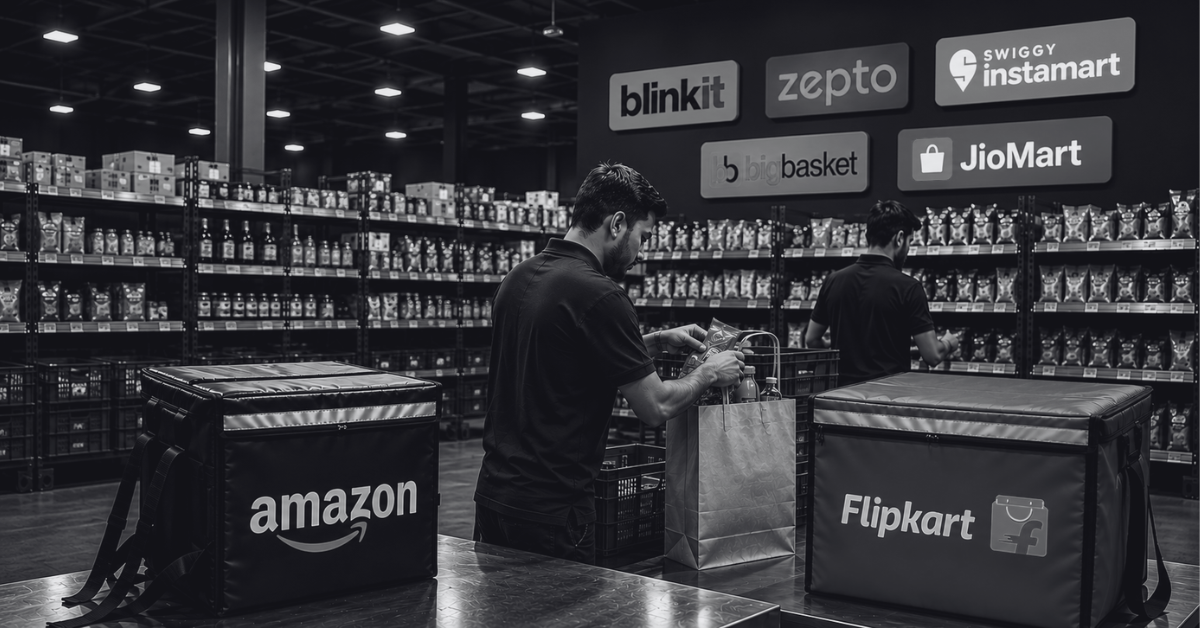
India’s quick commerce industry has entered a new phase of competition as e-commerce giants Amazon and Flipkart accelerate investments in dark stores and micro fulfilment centres to challenge established leaders such as Blinkit, Zepto, Swiggy Instamart, BigBasket, and JioMart.
The latest expansion announcements indicate that the battle is no longer limited to startups. The country’s two largest e-commerce platforms are now investing heavily in logistics infrastructure to capture a larger share of India’s booming instant delivery market.
Within days of each other, both companies unveiled ambitious expansion plans that could significantly reshape the competitive landscape over the next two years.
How Is Flipkart Minutes Expanding Across India?
Flipkart Minutes, the Walmart owned company’s quick commerce platform, recently crossed the milestone of 1,000 micro fulfilment centres across more than 130 cities and 8,000 PIN codes, less than two years after launching in August 2024.
According to the company, order volumes have grown fivefold over the past year, driven primarily by aggressive expansion into Tier II and Tier III cities.
Sources indicate that Flipkart Minutes is already preparing to expand beyond 1,500 micro fulfilment centres within the next few months, highlighting the speed at which it is scaling operations.
The company has also added more than 90 cities during the past year while witnessing a remarkable 42-fold increase in business across smaller cities and towns.
Consumer behaviour is also evolving rapidly. Flipkart said Gen Z customers now account for over 40% of its user base, with demand extending well beyond groceries into categories such as electronics, beauty, wellness, home essentials, and lifestyle products.
What Is Amazon’s Quick Commerce Strategy?
Amazon has unveiled an even more ambitious expansion roadmap for Amazon Now, its quick commerce platform.
Following CEO Andy Jassy’s visit to India and his meeting with Prime Minister Narendra Modi, Amazon announced plans to expand Amazon Now to more than 300 cities across India.
The expansion will be supported by over 1,000 micro fulfilment centres and more than 100 Urban Fulfillment Centers. Amazon currently operates more than 500 such facilities, indicating that the company plans to double its infrastructure footprint over the coming years.
The company had earlier committed a $300 million investment to strengthen India’s logistics infrastructure, with a significant portion earmarked for expanding Amazon Now.
According to Amazon, the platform has become the fastest-growing business within its Indian e-commerce operations, with order volumes doubling every quarter since launch.
The service currently caters to more than 50 million customers across over 15 cities, while Prime members using Amazon Now reportedly shop three times more frequently than other customers.
Why Are Dark Stores Becoming The New Battleground?
Dark stores have become the backbone of India’s quick commerce ecosystem.
Unlike traditional warehouses, these compact fulfilment centres are strategically located close to residential neighbourhoods, allowing companies to process and dispatch orders within minutes.
As customer expectations shift toward deliveries in 10 to 30 minutes, companies are racing to establish denser fulfilment networks that reduce delivery distances and improve operational efficiency.
The larger the network of dark stores, the greater the ability to maintain inventory closer to consumers, reduce delivery costs, improve service reliability, and expand product selection.
Consequently, infrastructure has become one of the biggest competitive differentiators in quick commerce.
Which Companies Currently Lead The Dark Store Race?
Blinkit remains India’s largest dedicated quick commerce operator with 2,243 dark stores spread across 243 cities.
Swiggy Instamart operates approximately 1,143 dark stores, closely followed by Zepto with 1,139.
Tata backed BigBasket has expanded its network to more than 900 dark stores nationwide.
Flipkart Minutes has already reached 1,000 micro fulfilment centres and plans to cross 1,500 shortly.
Amazon currently operates more than 500 centres but intends to expand beyond 1,000 while simultaneously increasing its city presence to over 300 locations.
If executed as planned, Amazon would have the widest geographic coverage among dedicated quick commerce platforms in India.
How Fast Is Competition Intensifying?
The pace of expansion has accelerated dramatically across the industry.
Blinkit added nearly 942 new dark stores during FY26, while Swiggy Instamart and Zepto expanded by 122 and 110 stores respectively.
Against this backdrop, Amazon and Flipkart’s aggressive infrastructure build-out signals that the competition is shifting from startup led disruption to large scale capital deployment by global technology companies.
Market share dynamics are also evolving.
A recent Entrackr report indicated that Swiggy Instamart’s share of orders among the three leading quick commerce platforms declined from 34.3% in FY24 to 20.9% in FY26, reflecting increasing competitive pressure.
How Is JioMart Taking A Different Approach?
Reliance owned JioMart is following a fundamentally different strategy.
Instead of relying primarily on dedicated dark stores, JioMart leverages Reliance Retail’s extensive physical store network to fulfil quick commerce orders.
During Reliance Industries’ recent annual general meeting, the company said its quick commerce operations span more than 3,100 retail stores across over 1,200 cities and 5,100 PIN codes.
This asset-light approach allows JioMart to utilize existing retail infrastructure while reducing capital expenditure associated with building dedicated dark stores.
What Does This Mean For India’s Quick Commerce Industry?
India’s quick commerce market has evolved far beyond grocery delivery.
Platforms are now competing across electronics, beauty products, fashion, healthcare, home essentials, personal care, and premium consumer goods.
As companies continue investing billions into logistics infrastructure, AI-powered inventory management, fulfilment automation, and last-mile delivery, the market is entering one of its most competitive phases.
With Amazon, Flipkart, Blinkit, Zepto, Swiggy Instamart, BigBasket, and JioMart all pursuing aggressive expansion strategies, industry consolidation may eventually become inevitable.
For now, however, the battle is being fought through faster deliveries, wider product selection, denser fulfilment networks, and deeper geographic reach as every major player races to dominate India’s rapidly growing quick commerce ecosystem.